Archive

Basic Topics on Innovation

HP Francois Martin

Photo: HP, 2013 

Great conversation about Marketing Innovation, current trend and Digital Print with
François Martin, WW Marketing Director Graphic Solution Business at Hewlett-Packard.

Interview by Andreas Weber

Why you should read this blog post:

• HP’s Francois Martin explains in an excellent way how to benefit from graphic solution technologies to do a better, sustainable marketing job — hitting the ”Zeitgeist“ perfectly. 
• His main target is to transform the product and solutions offerings of HP GSB into a valuable, customer centric and effective marketing communication success for his own purpose and for his customers and the customers of his customers. 
• He shows how to make the right step from technology innovation to market success by bringing Brand Owners/Agencies and Print Service Provides closer together and fulfilling their needs smartly. 
 
• His core messages related to ”Six reasons Digital Print belongs in your media mix”:

It cuts through email clutter by getting into the home to make an emotional connection.
It uses content and storytelling to build awareness and purchase intent.
It offers customers a chance to browse (vs. searching on a website).
It can be integrated with online tactics: digital editions, mobile apps, social media, and commerce websites.
It lets you finely target your list for both acquisition and reactivation of lapsed customers.
It provides tangible, measurable ROI.


PART 1 of the interview — Holistic perspective

Consumers know the brand ”HP“ very well, but Marketing and Communication professionals don’t recognize HP as an innovative brand for their specific business tasks. Do you think HP need to change the corporate brand communication strategy? 

Francois Martin: No. The Corporate Communication from HP is around a new style of IT addressing large corporation.

The Graphics Solution Business of HP (GSB) aiming at Marketing and Supply Chain Managers sitting in large Corporation needs to be addressed by one to one communication and then linked to Print Service Providers who make it happen.

What has been the most effective marketing campaign for HP GSB?

Francois Martin: The most effective campaigns are different depending on who we address:

If we address Print Service Providers the best campaigns are showing them a real sample, then showing them how it was produced in the demo center and then explaining the economics around it as they go beyond pure printing costs of a given item.

Addressing Brand Owners — show them a great marketing campaign done either by a competitor or in an other industry they can leverage. Once they are impressed or inspired they will want to know if they can do x, y or z and this is when they want to talk to a Print Service Provider who can tell them: Yes we can do it! — All start with an idea.

What differentiates the current and the future Marketing challenges for HP GSB? 

Francois Martin: Marketing is surfing on social trends – all is now mobile and social and all is in the ”Cloud“. This means that whatever you do has to be meaningful to small groups of people and to change fast as everything tend to have a short life.

Having said that you quickly understand digital is the best way to reach to your customers — either all virtual and mobile or printed in their mailbox, in the shops, on the shelves.

This is not about the how but the what — if you have great ideas, it will can be done.

In GSB our challenge is too remove perceptions about the power of print. Print has so much legacy. Some pages will disappear, others will emerge. Too many people refuse to see where print will go in a world where ”me“ as an individual need to be seduced and convinced — and it can not be done by email, blogs, Facebook and tweets only as it would be too easy. We are living in a world where all the content is liquid taking any shape anytime anywhere. It is about surprising the most.

What makes HP GSBs marketing communication approach surprising or unique?

Francois Martin: Our communication in unique in a sense that we need to address both the printers who print and the brand owners who ultimately order the print from the printers.

They both need to spend more time together to understand how digital has already transformed the world in which they leave. Honestly, who could have said, that Coca-Cola would produce more than 1 billion bottles using digitally printed labels to support one of their biggest campaign ever?

How do you plan to strengthen the combination of innovative HP GSB products/solution with the right Marketing strategy?

Francois Martin: It is about addressing the Brand Owners and the Print Service Providers where they are and using the terminology they understand.

It is about showing tangible benefits around digital printing and no longer explaining the size of the dot and the speed of the press.

PART 2 of the interview — Focused perspective

Where does the profitable print volumes come from in the future?
Francois Martin: Profitable Print volumes come from applications using either/or variable data printing, nice substrates, versioning to communicate a valuable content to raise emotion like I did not knew, I am impressed, super, can I know more, they do this?

How does HP GSB react to change in consumer behavior (infected by Mobile and Social Media)?

Francois Martin: The word is mobile and social — some of our campaigns can be seen on mobile devices and we facilitate discussions with our customers in industry forums such as dscoop or the Latex Leaning Center to come on-line for all the one who want to know more on HP Latex Printing

How does HP GSB interact with the relevant customers to push innovation?

Francois Martin: We are working closely with leading companies who set challenges for HP — we work closely with them to understand the type of features we need to enable to shape and built a brighter future for both the Brand Owners and the Print Service Providers.

To illustrate with names, we worked closely with Coca-Cola to make their ideas reality even developing a unique Coke Red color and special service capabilities to enable 24/7 printing on the HP Indigo WS6600 press. We worked closely with the leading EMEA book printer called CPI to develop our high speed inkjet web press which today help them to print many titles who no longer can be managed in traditional offset printing processes.

About Francois Martin

To get in touch via LinkedIn:
ch.linkedin.com/pub/francois-martin/1/295/5a9

Profile:
http://www.hp.com/hpinfo/newsroom/press_kits/2011/HPLatexSummit/FrancoisMartin.pdf

Value Check Offer mit Logo.008

© 2014 by Value Communication AG, Mainz/Germany


 ValueCheck Audits: Fast-track your communication success


Kommunikation ist (k)eine Kunst.

Es klingt fast profan, ist es letztlich aber doch nicht: Kommunikation setzt Dinge in Bewegung. Und werthaltige Kommunikation stellt den nachhaltigen profitablen Geschäftsverlauf sicher. In unserem Marketing-getriebenen Digital-Zeitalter sind neue Marketing-Kommunikationskonzepte, -maßnahmen und -wege gefragt, die Innovationen in den Fokus stellen. Doch leicht gerät die Suche nach Innovation zur  “Jagd nach dem Goldenen Kalb”. Zu viele “Buzz Words” und dubioses Experten-Kauderwelsch schaffen eher Verwirrung als Ordnung.

Abhilfe tut not.


Die zentrale Frage lautet:
Wie kann man die Kommunikationsfähigkeit eines Unternehmens bewerten? 

Die Analyse und Bewertung der Kommunikationsfähigkeit einer Unternehmung ist für ein erfolgreiches Marketing eine Grundvoraussetzung, um profitable Geschäfte und prosperierendes Wachstum zu ermöglichen. Bislang erfolgt dies in der Praxis aber nicht. Getestet und analysiert wird vielmehr, welche Kommunikationsmaßnahmen bei Image-/Markenaufbau und -pflege sowie bei verkaufs- und absatzfördernden Kampagnen welche Effekte bringen. Für jeden Kommunikationskanal gibt es eigene, spezifisch ausgelegte Auswertungskriterien.

Wir wissen zudem durch aktuelle Forschungsergebnisse, dass Sonderwerbeformen, ›Special Effects‹ oder Crossmedia-Kampagnen in der sog. ›werblichen Kommunikation‹ stets mehr bringen, aber auch stets mehr kosten [vgl. u. a. Dr. Peter Haller, GfK: ›Building Best Brands‹, München 2009]. Die Frage nach der bestmöglichen Wirkung spezifischer Kommunikationsmaßnahmen beantwortet aber noch nicht die nach der Qualität der Kommunikationsfähigkeit eines Unternehmens. Hier sind ganz andere Faktoren und Einflussgrößen zu bewerten, die weit über das Spektrum der klassischen Werbewirkungsforschung oder von ›Media-Audits‹ hinausführen.


Werthaltigkeit mit System

Die Werthaltigkeit der Kommunikation muss durch systematische Erforschung, kontinuierliche qualitative Überwachung und die zentrale Steuerung der Geschäftskommunikation erfolgen. Innerhalb unserer Value-Communication-Methodik erfolgt dies durch ein ›Value Check Audit‹.

Hier wird zunächst per ›ValueCheck‹ ein Fragenkatalog abgearbeitet, der acht zentrale Themenbereiche umfasst, die jeweils mit Detail-Fragen unterfüttert werden und deren Beantwortung im ›Ja-Nein-Keine-Angaben‹-Rhythmus abgearbeitet werden. Die Ergebnisse werden im ›Value Score Index‹ dargestellt. Die Befragung wird vom Value-Auditor mit Unternehmensentscheidern innerhalb von 45 bis 90 Minuten durchgeführt. Die Auswertung ergibt schlüssige, konkrete Anhaltspunkte für die Verbesserungs- und Innovationsmöglichkeiten der Organisation und Strukturen, der Kommunikationsarchitektur, der Kommunikationsprozesse, der Kommunikationskanäle und -mittel. 


Value System Implementation

© 2014 by Value Communication AG, Mainz/Germany


Weiterer Schritt: Vom Audit zum Benchmark

In Value Profile-Workshops können die Ergebnisse vorgestellt, diskutiert und in Handlungsempfehlungen inklusive einer Roadmap umgesetzt werden. Auf dieser Basis ist eine ganzheitliche Bewertung der Kommunikationsfähigkeit möglich; regelmäßige Updates erlauben, Verbesserungen vorzunehmen.

Zweckdienlich ist es, die ValueCheck Audits auf Branchen und Wirtschaftsbereiche auszudehnen, um über Benchmark-Vergleiche die eigenen Fähigkeiten kritisch prüfen und optimieren zu können. Über ValueCheck und ValueProfile erfolgt die strategische Analyse, die im Ergebnis das Design einer neuen Kommunikationsarchitektur liefert. Die Performanz der Kommunikationsarchitektur hängt von der Güte des Value Scoutings ab, dass heisst dem Aufspüren geeigneter, relevanter Kommunikationsinnovationen, die kontinuierlich auf Basis von Wissensvermittlung mit Best-Practice-Auswertungen in der Value Academy darstellbar sind. Das Aufspüren, die Auswahl und die Implementierung von Kommunikationsinnovationen muss als iterativer Prozess verstanden werden, der durch die Value Audits auf seine Wertigkeit und Wirkung überprüft und permanent optimiert werden kann.


Bei Interesse steht Andreas Weber für Fragen und Anregungen zur Verfügung.

Kontakt:
a.weber(at)value-communication.com 


Hier bitte klicken für weitere Informationen (in englischer Sprache)!


Hinweis

Unser einzigartiges Value Academy-Programm bietet passende Wissenmodule, die in die Methodik der Value Audits inkl. Value Check einführen und ad hoc erste Ergebnisse liefern. 


Value Eco-System Value Check.002

Print Re-Loaded

Text by Jenny Krepp, Value Marketing Fellow
Twitter: @JennysMindflash
Illustration by Lidia Lukianova, SF Bay Area


The term innovation and the name Schumpeter go hand in hand. Schumpeter is often called the father of innovation. He identified innovation as the critical element for economic change. Change is not only the favorite word of the current US President, but can be a critical element for something new. To create something new we do not necessarily need to change something radically, but we must at least develop something old further.

Schumpeter 2.0

Something Old:
Creativity x Risk = Innovation

Something New:
Innovation x Knowledge = Profitable Growth

Value Schumpeter 2_0 Garfik.067

Google is a prime example of a company who combines innovation and knowledge to grow successfully.

Andreas Weber, CEO Value Communication AG stated “Google followed Schumpeter’s innovative approach from their first steps as they innovated the search engine business which was founded and triggered by Alta Vista”. Furthermore, they developed dozens of additional technologies and services like Gmail, Android, Google Maps, Google+ and so on.

As a start up Google used Schumpeter’s approach (something old) to be innovative by creating new technological concepts. However, this tactic wouldn’t be sufficient in the long run.

The real key to Google’s long lasting success is knowledge sharing. They provide a consumer friendly platform, which is easy to use, for free and they share their knowledge about digital advertising and how to engage marketing with advertising executives. Moreover, Google provides smart tools for publishing and commercializing content and messages. Additionally, they place a high value on feedback disregarding if you use their platforms as a B2B or B2C user.

By combining something old with something new Google became extremely successful. As Andreas Weber adds “They started as an innovator and turn out to be the worlds leading knowledge provider in the digital age”.

What can we learn from Google’s success from a marketing perspective? 

It is no secret in the business world that marketing leads to business success. Marketing, as it is known today has been around since Schumpeter’s era but as Andreas Weber pointed out: “Since more then one generation marketing itself is not innovative”. However, to innovate marketing practices we not only need technological innovations, for example Google’s search engine but also relevant communication tools. Relevant tools are those, which are valuable, sustainable and desirable.

”Known by the motto you cannot know what you don’t know technology innovations only push through if they are communicated effectively – especially in the field of B2B” stated Andreas Weber.

Something Old:
Marketing leads to Business Success!

Something New:
Technologie Innovation + Communication Innovation = Marketing Innovation

Value Marekting Communication 2_0 Grafik.072

Interesting post by Ricoh on print communicaton business and the value of social media.

Source:


Twitter is a treasure trove of content so rich with data that scientists are using it to predict when someone will get sick with the flu. But what value does this data mine bring to businesses and marketers?  Twitter first officially addressed some of its most loyal users – brands – with theintroduction of its “Promoted Tweets” feature in 2010, which allowed companies to pay for tweets to appear prominently in the timelines of their followers and users searching on specified keywords.  While it was a monumental shift for the successful startup in search of a business model, it only represented a small step in tackling an essential aspect of marketing – relevance.

As Dan Berthiaume points out in his recent column, Twitter’s new “targeted tweets” feature goes a step further in offering companies relevance by allowing them to send their Promoted Tweets to specific audiences based on new dimensions – such as location, platform and device. This is an important improvement for advertisers who previously had to choose between “spraying and praying” (e.g. sending a tweet about a US-only promotion to all of their followers) or repeating their tweet multiple times to reach their target audience  (e.g. tweeting time sensitive content several times to ensure that it reached various time zones).

Both choices left much to be desired – and risked much to be lost; mass tweeting meant many people received irrelevant offers and repeated tweeting meant that potentially interested followers were being turned off by redundancy (and disinterested customers were being annoyed multiple times). According to Berthiaume, “Every customer is of magnified importance to an SMB, so potentially alienating customers by sending repetitive or irrelevant tweets is especially dangerous.”

Targeted tweets not only represent a key tactical avenue for marketers who are in the deployment stage of a Precision Marketing campaign, they also symbolize how social media is reacting to what we call “The Relevance Era”- and how indispensible data and analytics are in successful marketing campaigns.  In addition to leveraging the immediacy of their medium, companies such as Twitter are also using the structured metadata associated with status updates such as geolocation and device information to help marketers.

But what about the data that makes social media “social”? In the world of data analytics and predictive modeling, social media is considered “free-form” data – it lives outside of rating scales, checkboxes and multiple choice options and offers a unique, valuable type of information.  Sentiment analysis of social media is increasingly being addressed by software (Twitter even allows users to search for positive and negative tweets) and companies such as Gaylord Entertainment effectively use social media data to monitor customer issues in real time.  While metadata is useful, perhaps Twitter will also allow marketers to target users based on more abstract criteria, such as sentiment and meaning, in the future.

As tablets and mobile devices drive social media’s popularity and increase its value as a decision-making tool, and as businesses turn to social media to increase the ROI of their marketing spending, social media allows business to address almost all the steps of the Precision Marketing approach: gathering data, analyzing and modeling, deploying and measuring.

One thing is clear, whether its direct mail, email, or social media – sending out a marketing message is just a start; precisely targeting the right message to the right audience via the right channels is the most important part of the battle for hearts and minds of customers.

Read more about how companies have effectively used social media in Sandra Zoratti’s new book, Precision Marketing: Maximizing Revenue Through Relevance.


“Future generations will no longer organize themselves according to political systems in regionally limited states in the future, but rather form themselves to global communities according to their communicative ability.”

Kenneth Joseph Arrow, around 1970
(Born August 23rd 1921, Economist and Nobel Prize winner in 1972)

Amazon, Apple, Facebook, Google, Twitter and others show: Communication innovations based on truly good, new ideas are the engine of commercial success, especially if there are crises and structural changes to be mastered. The innovators model how the right balance between creativity and technology is created.

As already approved, the Internet does not pose to be a difficult, elaborate or expensive to distribute medium, but an area-comprehensive and inexpensively usable information and communication infrastructure based on digital technologies. This way the function and the usage of the media as we know it becomes less important. Reaching creative, intermedia communication systems and solutions based on new technologies that no longer cause breaks between information, advertisement, communication, and transaction becomes more important.

Doing the right thing to find what you are looking for

In order to regain balance between creativity and technology, the so-called creative heads from the business with advertisement in media must accept and understand the new role of digital communication technologies, which must always follow the principle of being “smart”, in order to be perceived as creative. In single cases, this already works: Apple has become a leading company that has mastered the transition from computer manufacturer to entertainment technology enterprise, and in addition possesses an incredible medial and emotionalising radiating power. However, Apple has never published its general philosophy in a White Paper, but by all means embodied and cleverly advertised the Digital Lifestyle through the person of Steve Jobs (and his followers).

In spite of all creativity and unbroken innovation drive, Apple stays true to itself and is still a high-tech company. However, mainly consumers are addressed and advantaged, meaning one acts on the levels of B2C. Whereas the boundaries are no longer clear, because many Apple-private-users do not want to forego Apple products at work. At least, it was possible to change our business lifestyle as well, driven by iPhone and iPad.

Definitions of terms

Creativity is an artificial word that appeared in England in the 14th Century, but has been in general use only since two generations. “Creativity” became popular as a term in order to form a counterpart to “intelligence” that had great influence over the intelligence tests invented in the USA since the beginning of the 20th Century. The Sputnik shock triggered a new way of thinking in the USA and Western Europe in 1957, as one could not believe that the Soviets were the first ones in space. The term intelligence is divided into two areas in science:

  • Crystalline intelligence, which includes everything the human is able to learn through fact knowledge and the experience knowledge that is built up;
  • Fluid intelligence that helps us, basically instinctively, to do the right thing for us without much contemplation.

Simply said: Both areas are coupled to the neuronal network in humans; crystalline intelligence promotes cultural development, fluid intelligence secures survival.

Contrary to intelligence, creativity is not obligatorily connected to the neuronal network. Our immune system is extremely creative, as it can develop millions of defence strategies in split seconds to fight intruders and make them harmless in the best case. In the Ancient Greek philosophy one spoke of the creative, that can give and take, and that was embodied by the figure of Eros. The Socratics see the origin of creative thinking in dialectics: Utter a thought, experience criticism, and this criticism leads you to re-think your original thought or opinion. The creative originates this process of critical reflection that profits from the power and effect of the dialogue.

In this respect, mass media (as they are not in dialogue) and also advertisement in these media is not creative, but an outflow of crystalline intelligence, whose effect is based on campaign ideas. Campaign ideas for advertisement in media use the principle of fluid intelligence; they must be driven by new ideas, to achieve effects especially in case of a poor to medium communication infrastructure in a team with mass media. As digitalisation, the Internet, W LAN, and the broadband networks that have perfected the information and communication technologies we have available, the value of the campaign ideas for advertisement in media is reduced, just like the traditional direct marketing campaigns characterised by push mechanisms, whose direct mailing are only still read by a single digit percentage of the target audience.

Technology appears as a term in the German-speaking region in the late 18th Century, and has its origin in the Ancient Greek (téchne and lógos, the production or processing teaching). Technology first describes the teaching or science of a technique. In today’s use of language, the term is frequently used as a synonym for technology. The term technology describes a method that is used to achieve a certain result. The term technology describes the knowledge in order to use these techniques (“How does it work? What experiences are there with it, what risks, and what possibilities?”).

Our communication — business as well as private, verbal or non-verbal — is determined through technologies in the shape of “Smart Technologies” that have their origin in highly developed information technologies. Smart technologies are not only limited to the invention and the construction of products or devices, they also always include the design, the aesthetics, points of interaction with the user, the operating menu, and convenience. Smart Technology-development is a highly creative process. And if you talk with top developers in Silicon Valley you are able to understand this and learn, that Smart Technologies always include all relevant communication and interaction aspects.

© 2014 by Andreas Weber, Value Communication AG, Mainz/Germany


As a suggestion

1. Rethink. The technology development advances us by taking us back to the origin of valuable communication.

2. Rate differently. Service providers or mediators in communication work are less relevant than creative innovation partners with Smart Technology competence in order to define and establish a new communication understanding in the team.

3. Rebalance. Technology ignorance is just as fatal as technology infatuation.

4. Experiment without inhibitions. Find ways and options of being able to consistently have a dialogue about the value of your relationships with customer and partners.

5. Act differently. Communication with a system makes the relevance, attractiveness, and consistent presence of mutual content the key criteria per personal and economic success.

6. Network correctly. Knowledge work profits from the striving or valuable communication and networking.

7. Philosophise. Descartes’ principle that made clarity and sophistication of thinking the maxim needs an “Update” as a contemporary version to flee from the claws of a pseudo pluralism. Suggestion: The “Cogito ergo sum” (“I think/doubt, therefore I am”) changes into “Communico ergo sumus” (“I communicate, therefore we are”).


++++++++++++++++++++++

About ValueCheck! and how it works

ValueCheck! is a unique approach. It unifies Communication, art and culture in three steps via Analysis, Audits and Coaching. 

Our POV: It’s time for a disruptive approach via ValueCheck!: The performance promise of Value Communication is “connect innovation to profit”. In order to realize this promise, a questionnaire including eight different parts is organized so that customers get an opportunity to check out their companies’ marketing communication level by answering ValueCheck questions.

After receiving answers, Value Communication promises to provide customers with the results based on Value Score Index. In this way, customers become more aware of their tendencies and inadequacies on track of making benefits in the market. They get a chance to increase the effectiveness of all communication activities with regard to the success of their companies.

Your benefits

• ValueCheck! is something like a fitness check-up to be prepared for The Age of the Customer.
• ValueCheck! delivers orientation how to optimize all dimensions of your internal and external business communication success.
• ValueCheck! guides you through the digital world to accelerate your profitable growth.

You want to check it out?

Just send us an email!
Or contact us via Facebook or Twitter!

a.weber{at)value-communication.com

https://www.facebook.com/ValueCommunicationAG

@ValueCommAG

More Information about Value Communication
http://valuetrendradar.com/about/


Text by Andreas Weber, CEO of Value Communication AG, Mainz
Germany’s leading Business Communications Analyst and Innovation Expert
Illustration by Lidia Lukianova, SF Bay Area

Contact: Twitter @zeitenwende007
Actually, everything could be quite simple: Our modern technology Eldorado makes everything better, faster, more effective. That is the theory. However, the adaptation rate for innovative solutions in the market will tend to take off. Its because of the high pace of technology development that we tend to have lost our orientation. In the least, we are overwhelmed by news and details. It is time to re-think what we should do in the future!
1. Mainstream is not more mainstream
Decision-makers need luck to track down relevant information for their own purposes. “Why’s that? We communicate so well and are more active as never before! ” — Well, who uses Twitter extensively, for example, has so far not gained an overview about what is really important or mainstream. The German Social media expert Benedikt Koehler stated: “The news and information streams, which we read on Twitter, Facebook or Flipboard, makes the social mainstream invisible. We lose a sense of where the mainstream cultural currents flowing straight and which it has already incorporated. Are we radical? Are we ahead or middle? The timeline is silent on these issues.”
This phenomenon applies not only to social, political and cultural developments, but also to our professional status and responsibilities in marketing and business communication.
2. Traditional services stumble
Hardly any agency, marketing or communications professional is satisfied with the promise of its technology innovation or production service providers. Even a good pitch does not solve the problem that you may know, and certainly not what you do not know. It only follows what appears to be currently plausible. Drawback: Tops could convert too quickly into flops. See AOL, Second Life, MySpace and more recently Facebook. Modern marketing and communication services quickly stumble on the rapidly changing realities. For example, billions were invested worldwide a few years ago in Flash programming. But Flash is mega-out … Does this relate to the sustainability paradigm?
3. Smart and bold concepts are in short supply
The value of innovation is measured in the practice of what can be optimized as to the status quo. BUT: If something is optimized, it is indeed optimal. Optimal improvement does not automatically means to find the best way. It lacks a radical concept, smart and bold approaches to the ‘tabula rasa’ principle (a situation in which there are no fixed ideas about how something should develop). Get rid off the old customs. New thinking is only created by other types of forms of creativity and consistent decisions for relevant technology solutions.
4. Just do not consider: A blast from the past!
The role has reverse effect: a traditional printing company in southern Germany, which already had become a cross-media service provider, felt overwhelmed and re-positioned itself to become print specialists again. Credo: We know best how to make quality prints. A few months later, the print shop was broke and filed for bankruptcy. Note: Technology innovation is irreversible. The wheel can not be turned back.
5. Expectations cannot meet you, you have to wake them up! 
Steve Jobs hated the focus group approach. And he was right. How can you ask someone about something, he does not know or he cannot imagine? Why do we not start again, talking to interesting people about interesting topics — instead of always pandering to as many channels, what we can do just great and supposedly deliver? “Liquid service” is the magic word, driven by creative discourses that can awaken and meet the expectations!
6. Do we need new business models?
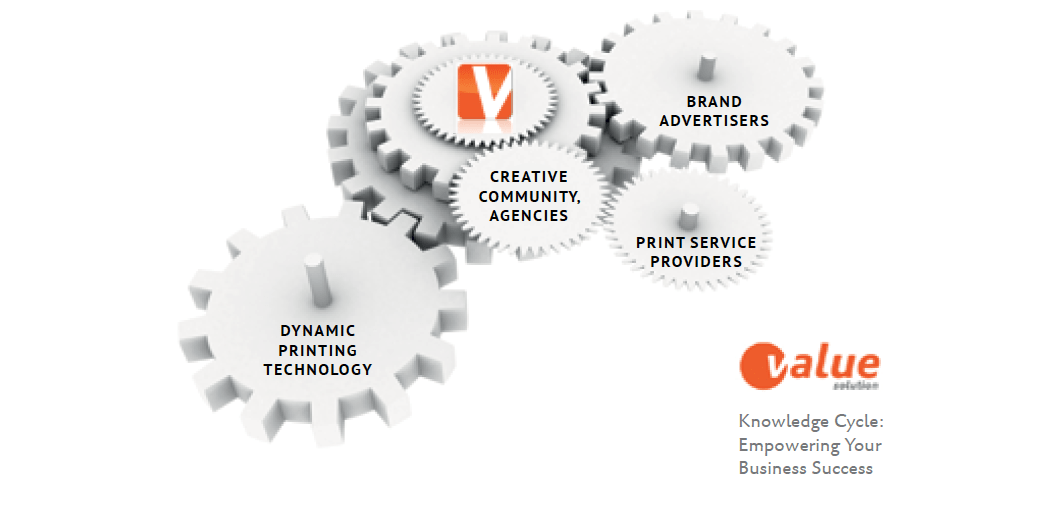
No! We need primarily a new business behaviour that makes it possible to confidently and creatively deal with technological innovations. We need new forms of cooperation between technology developers, brand owners and communication service providers (who create and produce media content). That means we need a new and efficient Eco-system for marketing and communications innovation that makes the value of technology innovations measurable (in a practical way).
7. Technology innovation to create value
Marketing alone cannot innovate a business. But technology innovated marketing — fundamentally can! The aims are to bring communication and transaction immediately together! Technology, by the way, describes the best approach to improve innovation through the skill to deal properly with knowledge.
And what is the added value?
Innovations allow the marketing community to convert prospects and customers into loyal fans — driven by relevant communication solutions.
Note
For other relevant tips and ideas for innovative solutions, contact Andreas Weber.