Archive

Tag Archives: digital age

ValuePublishing VDMA pre-drupa Pressekonferenz 2016.001

By Andreas Weber | GERMAN version

My comments: This was probably the most productive and therefore the most important event (with the business press) associated with drupa. Yes, market figures were given, but only as a guideline and to demonstrate that print is a growth market. The focus was far more on explaining from various perspectives how successful print business has transformed. No doubt some things will sound familiar. The important thing, though, in the run-up to drupa 2016 – which must cover a wider range of topics and exhibits than ever before – was to clearly establish the true context. And it was revealing to see how wholeheartedly all the key players (in this case the main decision-makers) at drupa, the world’s number one industry trade show, are behind their statements and publicity.

There’s no doubt about it – the world of printing isn’t what it used to be, but people have stopped bemoaning this fact and pressed the reset button. Nonetheless, anyone who still believes buying new equipment will ensure business success is mistaken and will fail. The new recipe for success will include holistic thinking outside the box, a comprehensive knowledge and excellent command of all process steps, automation, and the right, enlightened approach to digitization in the context of the sudden and rapid change in the demands placed on the printing sector.

In what was in my personal opinion the key speech, Dr. Gerold Linzbach talked about the true significance of digitization. Here’s an extract: “We’ve taken the vital step from focusing on technology to focusing on customers. (…) The benefit to customers is the top priority. We don’t simply apply technology for the sake of it.”

As Linzbach stressed, technology has to deliver “the optimum benefit for our customers and ultimately for whatever takes the industry forward.”

Welcome to the “Haus des Buches”

My report: The time and place for the exclusive pre-drupa business press conference were well chosen. We met on April 4, 2016 at the Haus des Buches (literally: house of the book) in the heart of Frankfurt am Main, a key financial center. The topics under discussion were market analysis, packaging, Print 4.0, and digitization. Our host was Dr. Markus Heering, Managing Director of the VDMA Printing and Paper Technology Association, who optimistically pronounced: “Print is an industry with a future.” As he sees it, print products are more than ever an everyday part of our lives and exhibit greater diversity than ever before. In his brief words of welcome, Messe Düsseldorf President and CEO Werner Matthias Dornscheidt was confident that the preparations for drupa 2016 couldn’t have gone better and it would be a resounding success, with appealing special events such as the drupa cube and an excellent supporting program providing the icing on the cake.
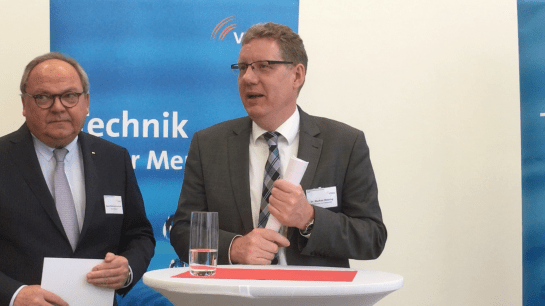
W M Dornscheidt und Dr. HeeringWerner Matthias Dornscheidt from Messe Düsseldorf and Dr. Markus Heering from the VDMA Printing and Paper Technology Association. Photo: Andreas Weber


Broad-based dynamic growth

“The global trend toward flexibilization and automation is currently playing into our hands. Germany’s press and paper machine manufacturers have been more successful than virtually any other mechanical engineering sector in making Industry 4.0 a reality,” continued Dr. Heering. Print 4.0, he said, was supporting Industry 4.0, and the extent to which print shops can improve their productivity and flexibility using fully networked digital work processes was already evident. Incoming orders for printing and paper technology were 10 percent up on the previous year in 2015, while press manufacturers saw a 9 percent increase in orders along with a slight fall in sales, especially in Germany. For manufacturers of postpress equipment, the increase in orders was as high as 21 percent. As Dr. Heering explained, “The sales figures also show it’s a long time since postpress technology was in such high demand. Sales climbed 13 percent in Germany and 9 percent in other countries.” He sees this as good reason to approach drupa 2016, the industry’s leading trade show worldwide, with renewed energy.

According to the VDMA, the key elements of networking and flexibility are emerging as visions and guiding principles for printing press and paper machine manufacturers, and there are three topic areas to be addressed:

  1. Flexibility in meeting specific customer needs
  2. Merging of technologies and functions
  3. Cooperation and standardization of interfaces

The focus is on the declared goal of strengthening print and paper by moving into new applications.


Claus Bolza-Schünemanndrupa president Claus Bolza-Schünemann, Chairman of the Executive Board of Koenig & Bauer AG (KBA). Photo: Andreas Weber


Packaging printing as a driver of print shop business

drupa president Claus Bolza-Schünemann, Chairman of the Executive Board of Koenig & Bauer AG (KBA), trained the spotlight on the packaging sector as a growth driver, stressing that traditional printing methods are leading the way here and are indispensable for the time being, but digital printing offers the possibility of new uses. “Together, flexographic and offset printing currently account for around two-thirds of the international packaging printing market, which was valued by Smithers PIRA at around US$415 billion in 2015. Digital printing’s share is still relatively small at approximately 3 percent, which leaves plenty of room for growth,” he said, adding that the packaging market for print shops is growing at a high level of 4 to 5 percent annually.

Bolza-Schünemann underlined that the total global sales volume for print was so high that it was hard to imagine. According to forecasts, sales will rise from their current level of just over US$900 billion to almost US$1 trillion by 2018. “The fact that ten years ago KBA was still generating a good 60 percent of Group sales in media-oriented print markets and only around 20 percent in packaging printing highlights the extent to which the printing world has shifted in the direction of packaging. Not entirely unintentionally, packaging now accounts for over 60 percent and publication printing just over 10 percent,” added the drupa president. In addition to outer packaging with high design and production standards, everyday packaging is now also becoming more important. Bolza-Schünemann is expecting the brown corrugated cardboard packaging currently used as standard in e-commerce to become increasingly colorful and believes this makes high-performance rotary inkjet printing ideal for the corrugated cardboard market.


My interim comments:

Global sales figures always sound good. And the prospect of print media manufacturers soon generating US$1 trillion is impressive, but at the same time highly abstract. Newspapers such as the Frankfurter Allgemeine Zeitung did pick up on this after the VDMA business press event, referring to signs of life from the world of printing on page 18 of its April 5, 2016 edition, confirming that print is a growth market, and pointing out that the printing industry’s turnover exceeds that of the automotive industry – but what does that really tell us? What’s more, these figures have been around for nearly 15 years. manroland AG defined them as the basis for its market research, but they were evidently little use given that the company went bankrupt. Far more exciting in my view is the question (which is not easy to answer) of the role print media are playing in the improvement in overall macroeconomic performance. If packaging is now being called the printing industry’s growth driver, all companies that are looking to physically sell products must focus 100 percent on print. That’s a clear and obvious statement, isn’t it? The imaging group Canon – also known for excellent specialist surveys about print and multichannel applications – has developed a convincing chart and is using it for
presentations. This makes the significance of print even clearer!


drupa president Bolza-Schünemann listed the following reasons for the strong, sustained growth of packaging:

  1. Printed packaging serves a protective, preservative, and advertising function for its contents and, increasingly, a communication function, too. Just think of consumer protection with appropriate references on the packaging.
  2. Packaging cannot be replaced by flatscreens or smartphones. Unlike printed newspapers or catalogs, it remains unaffected by the changed media behavior and actually tends to benefit from this.
  3. The global population is rising and international prosperity is increasing. The middle class with disposable income is growing in emerging markets such as China, India, and Brazil. Growing prosperity goes hand in hand with higher consumption and that in turn means more packaging and printing, all the more since shopping malls are springing up everywhere in emerging markets, too.
  4. Packaging is becoming increasingly classy and sophisticated – the only way to attract the necessary attention at the point of sale. This trend results in greater added value for the printing industry and machines with more elaborate configurations for the supply industry.
  5. More single-person households with a preference for ready meals and the booming online mail-order business are also driving growth.

What’s more, the influence of multichannel solutions, augmented reality, and personalization – which make all types of packaging the starting point for new contact and dialog options with the buyer – is creating huge potential for brand organizations (see the ValueDialog with multichannel developer Jacob Aizikowitz).


Kai Büntemeyer

Kai Büntemeyer, Chairman of the VDMA Printing and Paper Technology Association and Managing Partner of Kolbus GmbH & Co KG. Photo: Andreas Weber


The only solution – digital networking of the entire value-added chain

Businessman Kai Büntemeyer, Chairman of the VDMA Printing and Paper Technology Association and Managing Partner of Kolbus GmbH & Co KG, dismissed the prejudiced view that postpress is more or less an add-on to print media production. He warned against being tempted by offers to buy attractive new presses without thinking, and thus failing to consider the entire process chain and assess all networking options within and outside the print shop. It’s essential to have “a process world characterized by interoperability, open systems, and harmonized interfaces. The speed of the evolutionary processes under Print 4.0 stands and falls with the transparency of the players involved,” emphasized Büntemeyer, citing the example of the interface syntax provided by his company to download free of charge.

In the case of the printing and paper industry, he said it was important to distinguish between digitization on the one hand and digital printing on the other: “Digital inkjet printing is simply another process to be integrated into digitized process chains in the same way as conventional offset, flexographic or gravure printing. The printing process is just a small part of the complete chain.”

According to Büntemeyer, the overall process chain is as follows:

  • It starts with the receipt of digital job data;
  • continues with software-based job planning for optimized machine capacity utilization with minimal makeready times;
  • includes purchasing and HR planning;
  • and naturally all prepress and postpress process steps;
  • and it only ends with automated packaging, addressing, and shipping of the print products.

Although all this has long been established, he explained, it is only now feasible thanks to today’s high-performance technology, because only very recently have processor capacities, real-time communication, and big data software solutions enabled implementation in a way that is geared to the market.

Büntemeyer developed the following scenario, which shows postpress in a whole new light: “Sensory inline monitoring ensures consistently high quality, but the data collected can unlock added value. Monitoring the status of machines makes it possible to carry out preventive repairs, which enables downtimes to be planned. And service specialists can rectify many a fault remotely. The data collected is also used for anonymized benchmark comparisons in cutting-edge printing systems. Users can compare their performance and productivity with that of other users of the same systems.”

However, Büntemeyer also recognizes that, broadly speaking, the industry’s equipment is lagging behind these possibilities – by at least 10 to 15 years. During this period, there was too little process/solution-oriented thinking and insufficient investment. Networking between print shops is also recommended.


My interim comments:

It’s good that this has now been made clear, because I conclude that it’s ultimately no longer a case of optimizing details and maintaining the traditional silo mentality. New, sometimes disruptive, holistic, automated business processes and the corresponding reorientation of business models are now the order of the day. (N.B.: The 4th Online Print Symposium, which took place in Munich on March 17 and 18, 2015, revealed how far this has already progressed at extremely successful online print shops such as Onlineprinters, Flyeralarm, United Print, and CIMPRESS (see the article entitled “Zipper’s Insights: reporting from the 4th Online Print Symposium”).


Dr. Gerold Linzbach, CEO of Heidelberger Druckmaschinen AG, has realigned Heidelberg to focus on customers. Video: Andreas Weber (in german language).


“Digitization isn’t the same as digital printing!”

Dr. Gerold Linzbach, CEO of industry leader Heidelberger Druckmaschinen AG, followed his statement at the VDMA press event by summing up the company’s new role: “We’ve taken the vital step from focusing on technology to focusing on customers.” He said it was important not to make digitization just another buzz word that everyone uses without really knowing what it means or agreeing on a standard definition.

According to Dr. Linzbach, Heidelberg has, in discussions with customers and numerous market partners, defined three essential elements or levels of digitization for the print market. When understood correctly, digitization thus makes it possible to embrace the digital era through the automation and flexibilization of print.

The first essential element is networking in the sense of automatically passing on data (for press and downstream postpress operations) between machines with adequate interfaces to make all process steps transparent to users. Especially these days, when fragmented order books set the rhythm, automation through networking is absolutely vital. It’s the only way Heidelberg customers can, among other things, complete 3,000 or more orders per day. Success in smoothly incorporating digital printing systems via the print shop network also really pays off. In a short space of time, this has enabled Heidelberg sales staff to succeed in selling 1,000 OEM digital printing systems from Ricoh to print shops.

Once the job data has been received, the customer – that is to say the print shop – is automatically relieved of the decision as to the best production process to use, i.e. offset or digital printing. According to Dr. Linzbach, then, it’s all about seamless integration of all production resources that a print shop must use to minimize the data handling outlay. This is already standard in online printing and will spread to all areas of the printing industry. It’s also necessary if, as in the area of packaging, there is a huge increase in the amount of documentation required to prove, for example, that food was packaged in line with regulations.


Dr. Gerold Linzbach at the press conference. Photos: Andreas Weber


The second essential element is the variabilization of print, that is to say personalization or customization in the sense of frequently changing the print content, together with a wide variety of substrates/printing stock – by its very nature a strength of digital printing processes. Heidelberg has configured and developed a whole package of digital printing solutions for drupa 2016. This even involves printing at different locations, for example end customers printing muesli packaging with personalized designs at the mymuesli.com shop.

Connectivity plays an important role. According to Dr. Linzbach, it’s a mistake simply to rely on equipping presses with thousands of sensors that can read data in seconds and then store it in huge volumes. For a responsible technology manufacturer like Heidelberg, the challenge is to move from big data to smart data. In other words, data that is essentially suitable for any use needs to be filtered, selecting only the most important details from the mass of job, customer, and application data – that is to say the very things that are really relevant. It must be possible for this to happen automatically. To stop this sounding too theoretical, Dr. Linzbach gave an example. Heidelberg will be creating an e-commerce platform that automatically tells customers, for example, if something they order is incompatible with the equipment installed at their company. The aim must be to avoid outlay and above all mistakes, and to lessen customers’ workloads so that they can concentrate on their core activities.

Dr. Linzbach holds out the prospect of soon being able to operate even the most complicated technologies very easily, almost at the touch of a button – just like smartphones and tablets, which operate in a virtually self-explanatory way and produce exactly the desired results without the consumer needing to know about each and every technical function.

This is the only way to ensure that customers from the print shop sector can get on with their real work. According to Dr. Linzbach, the main task of someone running a print shop is not to deliver perfect print quality – that must be ensured by the company providing the technology – but above all to manage jobs and high order volumes, undertake marketing activities, and maintain contacts with customers.

And that brings us to the third essential element of digitization –reduce to the max using appropriate filters developed from customer and application know-how to combine all the technical possibilities and focus on what is actually relevant so as to turn data into productive information.

Dr. Linzbach’s conclusion: “The benefit to customers is the top priority. We don’t simply apply technology for the sake of it, nor do we simply install the maximum that is technically possible. We always try to combine it in such a way as to offer the optimum benefit for our customers and ultimately for whatever takes the industry forward.”


msd_banner_257_drupa2016_48_619x180_us-static1


N.B.: ValuePublishing offers comprehensive reports and constructive criticism relating to the important and above all relevant pre-drupa events. See in particular:

“drupa ante portas – Top topic for 2016: Print in the communications mix!”

“drupa ante portas: Is print (again) in the passing lane? YES and NO.”


AT A GLANCE:
Clippings from selected german newspapers

This slideshow requires JavaScript.

XMPie Jacob Key Visual.001

Interview by Andreas Weber | Click to access german version

It is always a great honor and pleasure to carry on a conversation with Jacob Aizikowitz, President XMPie, a Xerox Company. He was a pioneer in one-to-one communication solutions driven by technology innovations when he started XMPie to enable Cross Media, VDP and Web-to-Print applications. His expertise is unique because he is able to bridge his profound technical knowledge with market needs that anticipate customers’ demand. No wonder that XMPie today is one of the most advanced multichannel solution providers around the globe. Nevertheless there are a lot of news to talk about. —Note: right at the beginning of 2016 Jacob and his team sharpened what they do. They created a new Web platform to share their state-of-the-art multichannel knowledge, headed by the claim: MANY CHANNELS. ONE CONVERSATION.

At a glance:

  1. Discover: Multichannel gives the smart collaboration of print and online a new dimension.
  2. Participate: XMPie’s Cross Media 2.0 opened the door to everybody doing digital media to contribute / participate in multichannel with print using XMPie personalization technology.
  3. Crucial: to understand the business and to understand the technology.
  4. The biggest challenge: automation of the conversation.
  5. The Target: to achieve ’One Conversation’, practically with no constraints on what and how one does in the digital media.
  6. Outlook: embrace digital innovation to transform applications. Best example: packaging. Via multichannel, packages will become the starting point of a conversation between the brand and its consumers.
  7. drupa 2016: a great place to experience the power of multichannel!


Jacob’s key message:
”It is all about to enable creating individually relevant and timely interactive customer communications that span time and a mix of digital and print media touch points”.


Bildschirmfoto 2016-02-05 um 16.47.25


PART 1

Focus on multichannel innovation

Before we start our conversation: What is your definition of ”multichannel“?

Jacob Aizikowitz: Interacting with your audience — customers, partners, prospects — with individually relevant and timely communications across time and along touch points that span the media spectrum from print to digital. — One should say: “One Conversation”. — Without that, the communications might be technically multichannel but not appear to the audience as a continuous interactive and relevant individualized dialogue. Achieving “One Conversation” is the tough part (especially when multichannel includes print). This is exactly where technology comes in to make it possible without endless and impractical team coordination that sometimes spans different organizations (e.g., the brand, its print agency / provider, its digital agency …).

Back to the future: You started more than 15 years ago as a pioneer with a 121 approach to innovate print production and marketing services processes. Nowadays it is all about multichannel in a digital world. How does that matter?

Jacob Aizikowitz: Good question. First of all, in a digital world it is so important not to forget that Print is still important. For all of us. It would be great if more enterprises and brand owners point that out. Secondly, in founding XMPie we observed that for the marketing professionals personalization equated with Internet. And we knew that personalization is also possible in digital printing. This triggered our vision to bridge print and digital for personalization. Such a vision enabled the marketing professional to practice personalization as a strategy and not as a media choice. Such a vision enabled the evolution of Multichannel. 

Cross-media communication

What kind of changes in mindset or improvements did you made?

Jacob Aizikowitz: Now, through the years, we evolved our direction, adding Web2Print, adding analytics, and adding campaign planning and automation (Circle). We realized that these business applications became relevant to the marketing professionals and to service providers who want to upgrade the type of services they provide. Most recently — end of 2015 — we changed dramatically our approach to cross media, introducing Open XM and Cross Media 2.0 (all with our 8.0 software release for PersonalEffect).

Read as well:
”Ten Steps to Hitting the Sweet Spot with Your Multichannel Campaign“


What is the benefit?

Jacob Aizikowitz: With Cross Media 2.0 we opened our solution to enable our customer to use any choice of web design / development tools, not constraining them to one specific tool that comes with the solution. This made our solution an open platform, enabling state-of-the-art digital while still using the XMPie personalization so that print and digital — while being each state-of-the-art — will be synergistic, consistent, and effective. The heart of Cross Media 2.0 is the Open XM Technology stack. It allows one to use, say, WebStorm, WordPress, just plain HTML, and also, our Dreamweaver plug-in, all interchangeably, while developing communications for digital. It also allows to develop mobile apps and responsive designs. In a way it allows the digital designer / developer to continue using their tools and their workflows while developing individualized communications that are automatically consistent and synchronized and synergistic with the individualized communications that are developed for the print media.

Creative Tools.png

… so your focus was always on technology innovation?

Jacob Aizikowitz: Yes and no. Most important was that we learned through the years what the customers of our customers wanted. Those are business people and they need business tools to manage marketing and communication campaigns properly. So we integrated responses via Web/PURLs and we established business analytics available via dash boards. Finally we learned and promoted: multichannel includes multitouch functionalities!

Sounds that you made a very interesting journey…

Jacob Aizikowitz: …indeed. But what we never changed is our original design. Our fundamental view was right and still is! From the very beginning we give a lot of value to our customers helping them find the right balance of technology and client needs. It is always important for us to understand the business as well as to understand the technology.

Date Print VDP

In summary, what is the secret of all those technical inventions you made via XMPie? 

Jacob Aizikowitz: There are three main aspects: 1. Understanding the market and where its going. 2. Understanding how to apply technology in an innovative and elegant way in order to enable the market trends and address its emerging needs. 3. A holistic view at solutions, which was also reflected in our tag line: One to One in One.

In my understanding XMPie’s success is a result of a perfect team work. What are the top criteria to characterize that?

Jacob Aizikowitz: I agree. Team work is a must. Our top criteria are: Smart people who bring new dimensions and flavours of technologies. — Alignment which is focused on the customer. — An open culture to exchange opinions frankly and in a very creative way.

Digitalisation changes everything — all kind of biz, marketing and communication processes. IoT and Industry 4.0 make big progress to automate what we have to do. Is this a threat or a chance?

Jacob Aizikowitz: Tough question but not that difficult to answer. IoT means everything is connected. So in fact we have more data to deal with. That works well because we are already familiar in handling huge amounts of data. Industry 4.0 is driven by automation. — What I feel is that personalization and the ability to interact across time and media touch points are very much related to IoT and Industry 4.0. So, these are synergistic trends.

What is the biggest challenge?

Jacob Aizikowitz: The big challenge in my view: automation of the conversation. Therefore we made a big progress and are able to offer a special solution, named Circle which leads you from storyboarding to campaign automation.

Campaign Management.png

Note: Circle is a Software-as-a-Service (SaaS) solution for managing your multichannel plus multitouch marketing campaigns. Users can track results and find out which messages are working best with which people, in which context and in which media a.s.o.


Circle seems to be the next big step based on a new business level for your customers? Right?

Jacob Aizikowitz: Surely. In any case XMPie is an enabler for Industry 4.0 compatible services. Automating the dialogue with the individual, while keeping it engaging, relevant, and effective is the main challenge; this is extremely challenging when the dialogue spans print and digital touch points. Many in ’Marketing Automation’ are after this — DRIP campaigns, Nurturing, etc. — but the XMPie offering is unique as it blends the automation of the individualized dialogues with the powerful media personalization — including print media (even if not printed — like PDF) and interactive capabilities. All under one roof — One to One in One.

Sounds good for your customers. So, if they follow our advice XMPie customers will become the HUB for new services?

Jacob Aizikowitz: We aim to provide our customers with technology that will allow them to stay relevant and attractive to their customers. We need our customers to have the vision and innovation; our role is to bring them technology that lets them pursue their vision. Some were influenced by our technology innovation to take the visionary view and go after their dreams.

Is that the reason why Gartner Group analyzed end of 2015: ”XMPie’s rating as a Challenger in this Magic Quadrant reflects its strong ability to execute on marketing communications.“

Jacob Aizikowitz: We are happy about being a challenger. Gartner addresses a number of other players who make technology integratable with other systems. Their focus is on customer communication management [CCM]. The notion of CCM was invented as an evolution of transpromo coming from transaction document management solutions. But with XMPie we made already a step ahead: our technology is accessible and much more open following the new paradigm of multichannel and multitouch.


drupa 2016 highlights ENG

PART 2

Focus on drupa 2016: time for a change!

A milestone this year will be drupa 2016 end of May 2016 in Düsseldorf/Germany. Multichannel is one of the trade show high-lights. The drupa motto: Touch the future. What is your guideline and vision to create further success? Is the Graphic Arts market or the print industry community still the best target group for XMPie? 

Jacob Aizikowitz: As always drupa delivers a good context for XMPie and our customers. I recognize the fact that graphic arts and print service providers (PSP) are solid customer bases. Going after multichannel vision is now very critical for PSPs. This is because the enterprises — the brands — are shifting at light speed rates to individualization, dialogues, nurturing, automation a.s.o. Except that they have no clue how to properly blend it with multichannel that has print media in it. The PSPs must shift their business and capabilities to multichannel and automation in order to provide their customers with services that match their needs as they (the brands) shift to digital and automatic individualized marketing. Our technology is a critical enabler for these transformations that the PSPs must make; and it is our goal to continuously innovate to make sure that we stays relevant, technology-wise, for our customers!

Web2print

You mean at drupa there are still opportunities to transform established print businesses?

Jacob Aizikowitz: Certainly. The opportunities are huge especially when relating to digital printing business models beyond online printing. It is all about bridging concepts and technologies to be still relevant to new customers needs. With our recently released Cross Media 2.0 technology, we make it possibility for PSPs (and their customers) to practice multichannel with print in the mix, while having the freedom to use their tools and workflow of choice for the digital elements in that mix. This opens the door to state of the art digital solutions, to collaboration, and consistency and synergy between the digital and print media touch points in a dialogue.

This new approach for Cross Media, combined with Circle, makes the XMPie technology also directly relevant to the enterprises themselves, and it opens many possible avenues for Enterprise / PSP collaboration and business workflows. In addition for a future multichannel success all kind of brands and enterprises are relevant. We have to continue to involve and to guide them step by step to experience our drupa 2016 presentation.

Holistic View

You serve a range of premium marketing service solution providers around the globe. From your point of view, what make them unique?

Jacob Aizikowitz: Most of our customers are serving their customers in the best way to achieve a sustainable benefit from multichannel communication success. They had in an early phase clear visions to change what they did and are able to transform it into new business opportunities. Very important fact: all of our very successful customers are not afraid of all kinds of digital and/or disruptive technologies. It is all about the readiness to embrace innovation!

Last but not least: In my opinion the main challenge will be ”customer centricity” driven by high-value multichannel capabilities. Do you agree or disagree?

Jacob Aizikowitz: Of course I agree. The digital age is the age of the customer. Why? Your audience is always connected. You have to become part of their conversation and to be connected all the time. The old school marketing methods don’t fit in that scenario anymore. To create reach and awareness by mass media is no longer working in the same way as in the past. Brands are interested in a relationship, a dialogue, on-going, continuous, with their consumers or prospects. 

Overview

This is very clear from the high investments brands make in social media, seeking “likes” and leveraging these likes for marketing. One exciting avenue for such a relationship between the brand and its consumers is something most digital-centric brand marketers have not yet seen — its packaging. The package — a nicely engaging and attractive piece — is the perfect starting touch point for a dialogue with the mobile-holding individual. The ability to offer multichannel in a packaging context is hot and attractive, and we enable this.

So the best and most desirable example comes from the packaging world. Brand owners realized that a package achieved by a consumer is not the end of the story. It is the starting point of a conversation which will be managed by innovative multichannel communication processes. This is a huge opportunity for our customers to develop breathtaking new applications.


Ressources

Thanks for the great conversation, Jacob. What is the essence to summarize our talk?

Jacob Aizikowitz: Finally, it is all about strategy and technology. We kept our strategy pretty much consistent through the years. Main changes were adding Web2Print, adding Analytics, adding Campaign Management (Circle), and revising our approach to cross media. This last point is what we call Cross Media 2.0, and it embraces into the XMPie fold the leading methods and workflows of state of the art in digital today. It’s open and ready for collaborations. The reason this last point is important is because a service provider who wants to provide Multichannel services, must recognize that its customers most likely have capability in web design, web sites, etc. The brands most likely have a web team or a digital agency. So, for our customer to offer multichannel they cannot just dismiss the brands web team or web agency. With Cross Media 2.0 it’s now possible to collaborate and share and work together, using the full spectrum of tools and methods available for digital, while still leveraging the XMPie personalization engine — the exact same engine that will feed the print side of the multichannel endeavor.

Services

In summary: It is all about to enable creating individually relevant and timely interactive customer communications that span time and a mix of digital and print media touch points. —Jacob Aizikowitz

—END—


Jacob Aizikowitz

About Jacob Aizikowitz, XMPie, Inc. 

Dr. Jacob Aizikowitz is the president of XMPie, which he founded in 2000 with Israel Roth and Reuven Sherwin, as a spin off from Scitex. XMPie has since grown to become the leading brand for integrated cross-media personalization solutions. In 2006, Jacob and the team led XMPie to a successful acquisition by the Xerox Corporation (XRX), where it now operates under the name, “XMPie, A Xerox Company”.

In the early 90’s, while at EFI (EFII), Jacob guided the early stages of the Fiery™ and led the development of EfiColor™ and Cachet™. These technologies, together with work by Adobe and Apple, brought user-friendly, quality-color to desktop publishing. In the late 90’s, during Jacob’s second term at Scitex, he led the early stages of the R&D of the Creo Controller. In parallel, he and his colleagues developed Scitex VPS™ which became a leading, objects-based, page description language for variable data printing.

The success of VPS, indirectly, inspired the founding of XMPie, and promoted the vision of cross media personalization and the democratization of variable data publishing.

Jacob holds a Ph.D. degree in Computer Science from Cornell University.

ValueCheck! — Canon #InfoAtWork 26112014.001

© 2014 by Value Communication AG, Mainz/Germany Photos/Composing: Andreas Weber


Düsseldorf (Germany), 2. December 2014. Success from square one: Information at Work, the pan-European “Canon for Business” specialist conference, brought together more than 500 professionals from 13 different countries. 

“I am delighted with the highly competent, intelligent and perspicacious manner in which Canon has managed to bring together leading managers from various sectors and countries to discuss ideas affecting current and future developments in the field of digital information management. Well done!” was how the CEO of one data-analytics company rated the “InfoAtWork” conference held on 26th November 2014 in the German city of Düsseldorf.

Graham Page, Head of Information Management Business Development, welcomed – on behalf of Canon Europe – the more than 500 participants from 13 different countries to the InterContinental Hotel on Düsseldorf’s central boulevard, the Königsallee. He underlined the importance of tackling – in times of radical change – the most important subjects in hand, namely: to evaluate correctly data, information and knowledge; and apply them efficiently to all the needs of the business concerned. This is crucial for sustainable success, profitability and customer and employee satisfaction.

“Information is beautiful” 

London-based designer, IT journalist and bestselling author David McCandless guided the audience through the paradigm shift in the field of data analysis which has already taken place, in the sense of “data science” having taken over from “business intelligence”. Mr. McCandless brought the presentation to life with a series of interactive and informative graphics. The resulting “digital data storytelling” proved to be fascinating for all those present.

As Marc Bory, European Director Solutions & Managed Services at Canon Europe put it:

“The global volume of data handled by business organisations is growing at an annual rate of 56%.” This means that the volume of data doubles every 18 months. Canon has positioned itself as a provider of “one-stop shop” solutions for the management of data input, data processing and the distribution of data-driven documents to their corresponding addressees. Hans Kaashoek from Strategy Partners stressed the significance of data sharing, given that mobile devices such as smartphones and tablet computers are creating a gateway to the sharing economy. “Mobile is the new desktop” was this analyst’s way of putting it, referring to the stunning changes affecting both work and day-to-day life in general. Organisations of all types have had to adapt to this new culture of social media and sharing if they wish to survive.


Part of conference conducted by personal tablet

Canon provided all participants with the use of a tablet pc, with a view to focusing on social media communications as a complement to the conference’s main events. Participants were able to use the Canon App interactively for voting on the afternoon presentations above all, while using it to contact other colleagues present at the event.

The seminars were used to host high-level expert discussions on the hands-on application of practical ideas. The common thread running through these sessions was the automation of processes at all levels, i.e. including the automation of key information-handling procedures. Various Canon customers reported on the fast and completely trouble-free implementation of new P2P (purchase to pay) solutions, preceded by an analysis by Canon experts designed to make available – virtually overnight – an individual, 100%-correct solution.

Michael Bjerre Drohst, CFO of the Creativ Company, a Danish organisation, highlighted the optimised purchasing process made possible in this respect, and its effects, saying: “It was fantastic. It took just a few days for the smoothly implemented Canon solution to improve how we cope with the accounts of our approximately ten thousand suppliers. This took the pressure off us, allowing us to focus once more on our actual core task of putting new, strategically based ideas into practice.”  Similar success was reported by Erna van Laar, who turned to Canon to help implement a digital mailroom facility for all human resource-related tasks performed at Connexxion, a Netherlands-based transport company. All the processes concerned were optimised in just three months, with strict data-security maintained and to the satisfaction of the employees involved, while delivering considerable savings in terms of the corresponding return-on-investment period.

Innovation and expert knowledge are key factors

Process automation also requires a change of attitude to outsourcing. While the main issue in this respect was previously cost savings, the task has now moved on to how to take advantage of technological expertise and innovation. RPA (Robotic Process Automation) is not concerned with which service provider delivers the goods, but rather with how delivery by drone will become possible.

Rudolf Wolf from WWK Lebensversicherung showed how the automation of process-oriented document management is no longer a thing of science fiction. AS an insurance WWK generates 80 million pages of documents every year. These are supplied to customers as both physical printouts and digital files, all of which need to be correctly addressed and reliably delivered, even with wide seasonal fluctuations and high verification standards. These aspects were also stressed by Peter Paul Bos from PostNL, the Dutch post office service. Transaction-related documents such as payment reminders and invoices must be physically printed out and addressed, and also delivered as “smart” text messages or even, nowadays, sent as direct messages via Twitter. This was how Mr. Bos confirmed Canon’s approach: “Automated document management means bringing the entire information process of a business organisation under control – including all documents, all sources of information, all addressees and all relevant means of transport (in a similar way to their digital counterparts).”

Manuel Sánchez, European Solutions Marketing Professional, Canon Europe, concluded the event with a presentation on Canon solutions for Customer Communications Management. The focus in this respect is no longer on individual solutions in transactional and/or promotional terms, but rather on providing a consistent customer experience across all media channels. No type of data analysis should ever be an end in itself, but must rather always focus on the customer’s well-being and satisfaction. If this is not taken into account, the customer will soon go elsewhere.

Further information can be obtained via the Twitter hashtag #InfoAtWork or the Canon Business Hub at http://www.canon.de/business-bytes

Please check our Storify story as well:

ValueCheck! @Storify 26112014

ValueCheck! — Canon #InfoAtWork 26112014

© 2014 by Value Communication AG, Mainz/Germany. Photos/Composing: Andreas Weber


Canon for Business Fachkonferenz “Information at Work” folgt dem Motto “Knowledge is beautiful”

„Ich bin sehr begeistert, mit welch hoher Kompetenz und kluger Umsicht Canon es schafft, dass sich Führungskräfte aus unterschiedlichen Branchen und Ländern über das Heute und Morgen im Digital Information Management austauschen können. Kompliment!“, kommentierte der CEO eines Data Analytics-Unternehmens die „InfoAtWork“ Konferenz, die am 26. November 2014 in Düsseldorf stattfand.

Graham Page, Head of Information Management Business Development, begrüßte im Namen von Canon Europe die über 500 Teilnehmer aus 13 Ländern im Düsseldorfer InterContinental an der Kö. Er unterstrich, wie wichtig es sei, sich in Zeiten radikalen Wandels mit den wichtigsten Themen auseinanderzusetzen: Daten – Informationen – Knowledge richtig zu bewerten und für alle Unternehmensbelange wirkungsvoll einzusetzen. Dies sei entscheidend für nachhaltigen Erfolg, Profitabilität, Kunden- und Mitarbeiterzufriedenheit.

„Information is beautiful” 

Der Designer, Datenjournalist und Bestseller-Autor David McCandless, London, führte das Publikum in den Paradigmenwechsel bei der Datenanalyse ein, der schon stattgefunden hat: „Data Science“ habe „Business Intelligence“ abgelöst, was McCandless gekonnt mit interaktiven Info-Grafiken anschaulich machte. Für die Teilnehmer war es faszinierend, seinem Digital Data Storytelling zu folgen.

„Das globale Datenvolumen, das in Unternehmen erzeugt wird, wächst jährlich um 56 Prozent“, legte Marc Bory, European Director Solutions & Managed Services bei Canon Europe, dar. Das bedeutet, dass sich das Datenvolumen alle 18 Monate verdoppelt. Canon positioniere sich als „One Stop Solution“-Anbieter für das Management von Dateneingang, Datenverarbeitung und der Verteilung von datengetriebenen Dokumenten an ihre Adressaten. Hans Kaashoek von Strategy Partners betonte die Bedeutung von „Data Sharing“, wobei Mobilgeräte wie Smartphones und Tablets das Gateway zur Sharing Economy seien. „Mobile is the new Desktop“, sagte der Analyst und verwies auf fulminante Änderungen im Arbeitsprozess und -alltag. Unternehmen aller Art müssten sich auf diese neuen Social Media und Sharing Kultur einstellen, wenn sie überleben wollten.


Per persönlicher Tablet App Teil des Konferenzgeschehens

Canon hatte allen Konferenzteilnehmern ein Tablet zur Verfügung gestellt und fokussierte Social Media Kommunikationsmaßnahmen flankierend zur Konferenz geboten. Die Teilnehmer konnten per Canon App interaktiv per Votings an den Vorträgen vor allem der Nachmittagsvorträge mitwirken oder auch Kontakt zu anderen Konferenzteilnehmern aufnehmen.

In den Seminaren ging es auf fachlich höchstem Niveau um Themen aus der Praxis für die Praxis. Leitlinie war die Prozessautomatisierung auf allen Ebenen, sprich die Automatisierung aller wichtigen Informationsprozesse. Canon Kunden berichteten über die rasche und völlig problemlose  Implementierung von neuen P2P-Lösungen (Purchase to pay), der eine Analyse durch Canon Experten vorausging, um quasi über Nacht eine individuelle und hundertprozentig passende Lösung nutzbar zu machen.

Den dadurch möglichen optimalen Einkaufsprozess und seine Effekte schilderte Michael Bjerre Drohst, CFO der Creativ Company, Dänemark: „Es war fantastisch. Innerhalb von wenigen Tagen lief die Canon Lösung reibungslos, um mit unseren rund 10.000 Lieferanten in ihren Abrechnungen besser zurechtzukommen. Wir konnten uns stark entlasten und uns wieder den eigentlich Aufgaben widmen: strategisch überlegt neue kreative Ideen umsetzen!“

Ähnliches berichtete die Beraterin Erna van Laar, die mithilfe von Canon für das Transportunternehmen Connexxion in den Niederlanden für alle Human Resource Aufgaben ein Digital Mailroom-Konzept umsetzte. In nur drei Monaten wurden alle Prozesse optimiert, unter Einhaltung strengster Kriterien für Datensicherheit und zur Zufriedenheit der Mitarbeiter. Gleichzeitig wird durch Einsparungen der Return-on-Invest-Zeitraum erheblich verkürzt.

Innovation und Expertenwissen sind Schlüsselfaktoren

Die Prozessautomatisierung erfordert auch ein Umdenken bei Outsourcing. Ging es bis dato zumeist um Kostenersparnis, verschiebt sich die Aufgabe, erweiterte technologische Expertise und Innovation nutzbar zu machen. RPA (Robotic Process Automation) bedeute, nicht welche Dienstleister liefert meine Ware aus, sondern wie wird die Lieferung per Drohne möglich.

Dass die Automatisierung im prozessorientierten Dokumentenmanagement  keine Science Fiction ist, zeigte Rudolf Wolf von WWK Lebensversicherung. WWK produziert pro Jahr 80 Millionen Seiten, die sowohl gedruckt als auch digital dem Kunden sicher und richtig adressiert zur Verfügung gestellt werden. Und das bei starken saisonalen Schwankungen und bei hohen Anforderungen an Überprüfbarkeit. Diese Aspekte betonte auch Peter Paul Bos von der Niederländischen Post, PostNL. Transaktionsdokumente wie Zahlungserinnerungen und Rechnungen  müssen sowohl gedruckt als auch intelligent per Text-Botschaften adressiert und ausgeliefert werden. Inzwischen sogar als Direct Message per Twitter. Bos bestätigte damit die Sichtweise von Canon: „Automatisiertes Dokumentenmanagement bedeutet, den gesamten Informationsprozess im Unternehmen unter Kontrolle zu bringen – alle Dokumente, alle Quellen, alle Adressaten und alle relevanten Transportwege, analog wie digital.“

Manuel Sanchez, European Solutions Marketing Professional bei Canon Europe, stellte zum Abschluss die Canon Lösungen für Customer Communications Management vor. Im Zentrum stehen dabei nicht mehr Einzellösungen für den Transaction und/oder Promotional Bereich, sondern die konsistente Kundenerfahrung über alle Medienkanäle hinweg. Jede Form der Datenanalyse darf nie Selbstzweck sein, sondern müsse stets das Wohl und die Zufriedenheit des Kunden in den Fokus stellen. Werde das nicht berücksichtigt, sei der Kunde sofort verloren.

Weitere Informationen finden sich über Twitter unter Hashtag #InfoAtWork oder per Canon Business Hub im Internet http://www.canon.de/business-bytes


Bitte nutzen Sie auch unsere Story per Storify.com mit den wichtigsten Tweets und Bildimpressionen im Überblick.

ValueCheck! @Storify 26112014

Canon Event Info 26112014.001

@ 2014 by Value Communication AG, Mainz/Germany. Screenshots: Canon Websites

Information at Work: Premiere einer exklusiven europäischen Canon Fachveranstaltung für Marketing, IT und Finance

Laufende News zum Event am 26.11.2014 ab 9 Uhr per Twitter,
#InfoAtWork

Aus 13 europäischen Ländern treffen sich am 26.11.2014 in Düsseldorf über 300 Unternehmensvertreter aus Marketing- und IT-Führungsebenen sowie der Finanzbranche. Eingeladen haben Canon Deutschland und Canon Europe. Motto der exklusiven Konferenz ist „Information at Work“, alles rund um Information Management und Digital Transformation.

Gezeigt werden aus der Praxis für die Praxis relevante Konzepte und Lösungen, wie man die Verfügbarkeit, Zugänglichkeit und Qualität von Geschäftsinformationen innerhalb des eigenen Unternehmens flexibel, wirksam und nachhaltig verbessern kann. Hochkarätige Experten und Unternehmensvertreter aus verschiedenen Branchen referieren in Vorträgen und Seminaren, die von speziellen Beratungs- und Servicezonen flankiert werden. Eröffnungsredner der Konferenz ist der Informationsdesigner und Journalist David McCandless, Autor des internationalen Bestsellers „Information is Beautiful“.

„Canon als führender Imaging-Konzern verfügt über eine umfassende Kompetenz und Erfahrung im Umgang mit Information und Technologie. Wir können dies durch spezifisch ausgelegte Lösungen für die Praxis nutzbar machen. Schwerpunkt ist ein integrierter Ansatz, der die komplexer werdenden Unternehmens-Aufgaben über die IT-Abteilungen hinaus für Marketing, Services und Vertrieb als Ganzes erfolgreicher gestaltet“, erläutert Roland Seehuber, Country Manager Solution Business Sales Development, Canon Deutschland GmbH.

Der Konferenz-Vormittag bietet Vorträge im Plenum, die simultan übersetzt werden. Neben David McCandless spricht der Marktforscher Hans Kaashoek, Strategy Partners Nederland, über Marktrends und technische Entwicklungen im Information Management der Zukunft. Der Konferenz-Nachmittag widmet sich in hochkarätig besetzen Seminaren den Themen „Next Generation Outsourcing“ (Jamie Liddell, Herausgeber Outsource Magazine), „Dokumenten-Prozessautomatisierung“ (Rudolf Wolf, WWK Lebensversicherung), „Kundenkommunikationsmanagement“ (Peter Paul Bos, PostNL, Niederlande), „Optimaler Einkaufsprozess — Purchase to pay“ (Michael Bjerre Drohst, Creativ Company, Dänemark) und „Digitale Poststelle“ (Erna van Laar, CONEXXION, Niederlande).

Canon wird die Konferenz „Information at Work“ für die Teilnehmer umfassend dokumentieren. Ergebniszusammenfassungen werden im Canon Business Hub in verschiedenen Blogposts publiziert.

Siehe auch unsere Tweet-Doku per Value Storify via @zeitenwende007.

Value Check Print Intelligence by Sükran 2014.001

© 2014 by Value Communication AG, Mainz/Germany


Bringing Intelligence to Everything – But Without Renewing Your Analogue Approaches?

By Şükran Ceren Salalı, Value Communication Fellow


Printability and Graphic Communications Institute has prepared a presentation which highlights various important facts about printing and its relation with marketing. The presentation is interesting and effective as well as it is well structured as a whole. However, there are several aspects that are mispresented.

The presentation is very well structured:

• It begins with a catchy sentence and an outline with key factors such as global context, the critical role of ICT, the “digital Darwinism” of the printed applications and evolving needs, responsive solutions.

• In the global context, subjects such as globalization, food and drug safety, increasing population, individualization and aging population are mentioned in order to present societal changes. Also, the data of consumer tendency, products and consumption are included in this part which is useful.

• Under the title of the critical role of ICT, three major facts; multi-device access, cloud computing and social network, are touched upon in relation with the fact that business approaches are changing with the high level use of mobile internet and social networks.

• When it comes to the digital Darwinism of the printed applications, the evaluation of consumer behavior is visualized starting from Gutenberg’s invention of mechanical movable type setting and also foreseeing the future, 2020s. I think the expression and the content is satisfactory.

• Lastly, in the part of evolving needs, responsive solutions, adoption of printing technologies by customer and by manufacturer are explained in a detailed way step by step.


Our Take: Yeah! BUT good is not good enough!

It seems like Bois and Canet did a good job by preparing an effective and explanatory presentation. The thing is, in the end, they recommend that print should fulfill the needs of marketers to push advertising campaigns. In the age of digital transformation, it is a big mistake to limit advertising and marketing based only on printing like we already know it. There are many platforms and social networks to work on in order to advertise a product or a system by drawing attentions. The age of the so called „digital transformation“ needs better rethinking over analogue approaches in order to satisfy consumer needs in a best way.


++++++++++++++++++++++++++++++

If you would like to find the right way to reach your communication targets:
Please check out our ValueCheck!